Project Detail /
Drug Recognition Based on Deep Learning Models to Enhance Medication Safety
A deep-learning-driven recognition pipeline for medication safety, designed to retain prior visual knowledge while learning newly added drug classes.
01. OVERVIEW
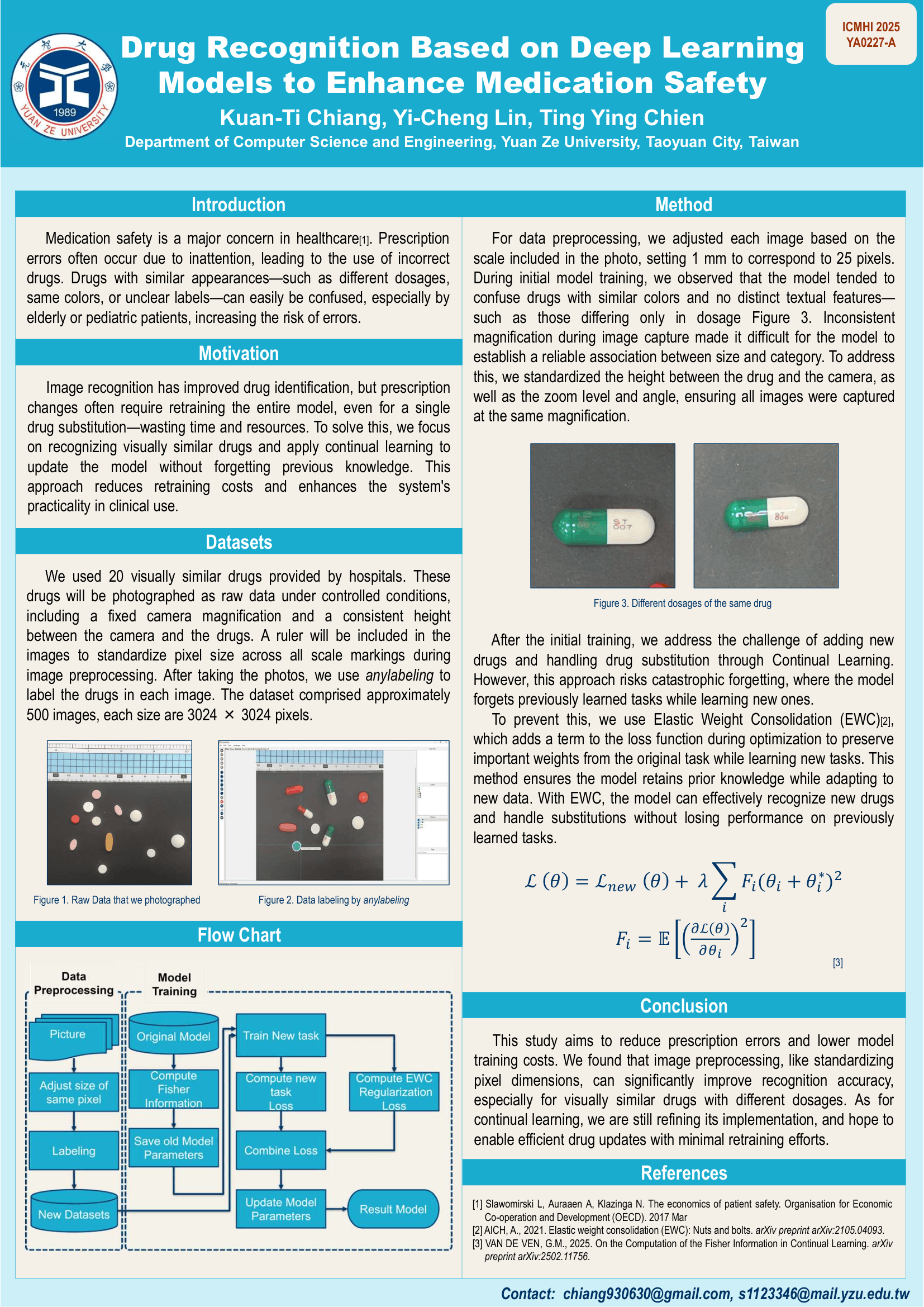
Deep Learning-Based Medication Recognition with Continual Learning Integration Medication errors remain a critical concern in healthcare, often caused by the visual similarity of different drugs or dosages. While AI has improved identification accuracy, clinical environments demand frequent updates as new drugs are introduced.
This project develops a robust recognition pipeline that not only distinguishes highly similar medications through advanced image preprocessing but also incorporates Continual Learning to allow the system to adapt to new drugs without the need for costly full-model retraining.
02. PROBLEM_AND_APPROACH
Problem
Catastrophic Forgetting & Visual Ambiguity
Standard deep learning models suffer from "catastrophic forgetting," losing prior knowledge when trained on new medication classes. This is compounded by "visual ambiguity," where drugs share identical colors and shapes, differing only in physical scale (e.g., dosage levels) that conventional models struggle to distinguish.
Approach
Knowledge Preservation & Geometric Standardization
This project implements Elastic Weight Consolidation (EWC) to preserve critical neural weights, allowing the model to learn new labels without forgetting old ones. We also integrate geometric standardization (pixel-to-physical-size mapping) to capture precise dimensions, providing a stable and cost-effective solution for accurate pharmacy automation.
03. PROJECT_CAROUSEL